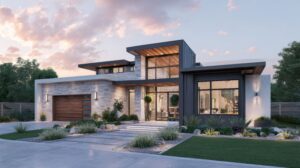
A well-designed roof system must balance structure, material, drainage, and long-term durability. Understanding how each approach works allows you to make a decision that aligns with both design intent and real-world performance.
Section 1 — Understanding How Roofs Are Built
Most residential roofs in wood-frame construction follow one of two structural approaches:
- Hand-Framed Roofs
Built on-site, allowing for custom geometry and architectural flexibility. - Prefabricated Trusses
Factory-built systems designed for efficiency, speed, and consistent structural performance.
The structure defines the shape.
The roofing assembly—the visible material—determines durability, maintenance, and lifespan.
Section 2 — Flat Roofs: Where They Work Well
What a “Flat Roof” Actually Is
Flat roofs are not truly flat. They are designed with a minimum slope (~2%) to allow water to drain properly.
Common Systems
- Torch-on or EPDM membrane systems
- Typically 2–3 layers
- Installed quickly and efficiently
Advantages
- Lower upfront construction cost
- Faster installation timelines
- Easier access for maintenance
- Strong alignment with modern architectural design
Limitations
- Drainage must be carefully designed and executed
- More sensitive to installation quality
- Limited visual appeal if exposed to street view
Section 3 — Sloped Roofs: Where They Perform Best
Common Roofing Materials
- Asphalt Shingles
Cost-effective and widely used
Lifespan: 20–30 years - Standing Seam Metal
High-performance and long-lasting
Lifespan: 40–50+ years - Tile (Clay, Concrete, Slate)
Durable and architectural
Lifespan: 30+ years - Wood / Cedar Shingles
Used for high-end or traditional applications - Rubber Shingles
Lightweight, durable, long lifespan
Advantages
- Natural water and snow drainage
- Longer lifespan depending on material
- Greater flexibility across architectural styles
Limitations
- Higher upfront cost
- Longer installation timelines
- Reduced accessibility for maintenance
Section 4 — What Actually Drives Cost and Longevity
This is where most homeowners make the wrong decision.
1. Material Must Match the Roof Slope
- Flat roofs require membrane systems
- Shingles require adequate pitch (typically 4:12+)
- Metal systems can work on lower slopes
- Tile requires steeper slopes and stronger structure
2. Roof Complexity Matters More Than Type
Cost increases with:
- Valleys and intersections
- Skylights and dormers
- Multi-level roof forms
- Integrated drainage systems
Simple roofs perform better and cost less.
3. Installation Quality Is the Deciding Factor
A poorly installed roof will fail regardless of type.
The difference between a 15-year roof and a 40-year roof is often not the material—it is the execution.
Section 5 — Cost vs. Lifespan Comparison
| Roofing Type | Cost Range | Typical Lifespan |
| Asphalt Shingles | Low | 20–30 years |
| Torch-On / Membrane | Low–Medium | 20–30 years |
| Wood / Cedar | High | 20–30 years |
| Tile (Clay / Concrete / Slate) | Medium–High | 30+ years |
| Metal Roofing | High | 40–50+ years |
| Rubber Shingles | Medium–High | 50+ years |
Section 6 — What Works Best in Vancouver
In the Lower Mainland climate:
- Rain management is critical
- Moisture control is more important than temperature extremes
- Long-term durability depends heavily on detailing and installation
General guidance:
- Sloped roofs perform more reliably with less maintenance
- Flat roofs work well when properly detailed and maintained
- Both systems can succeed when designed intentionally
Section 7 — Final Decision Framework
Choose based on priorities:
Choose a Flat Roof If:
- You want a modern architectural expression
- You are optimizing for initial construction cost
- You understand and accept ongoing maintenance
Choose a Sloped Roof If:
- You want long-term durability and lower maintenance
- You prefer a wider range of material options
- You are designing for performance over time
The best solution is not universal.
It is project-specific.
Conclusion
Roof design is not simply a choice between flat and sloped. It is a coordination between structure, material, drainage, and execution.
When these elements are aligned early in design, the result is a system that performs predictably, ages well, and supports the long-term value of the home.